
Introduction: Turn Online Visibility into Valuable Business Opportunities
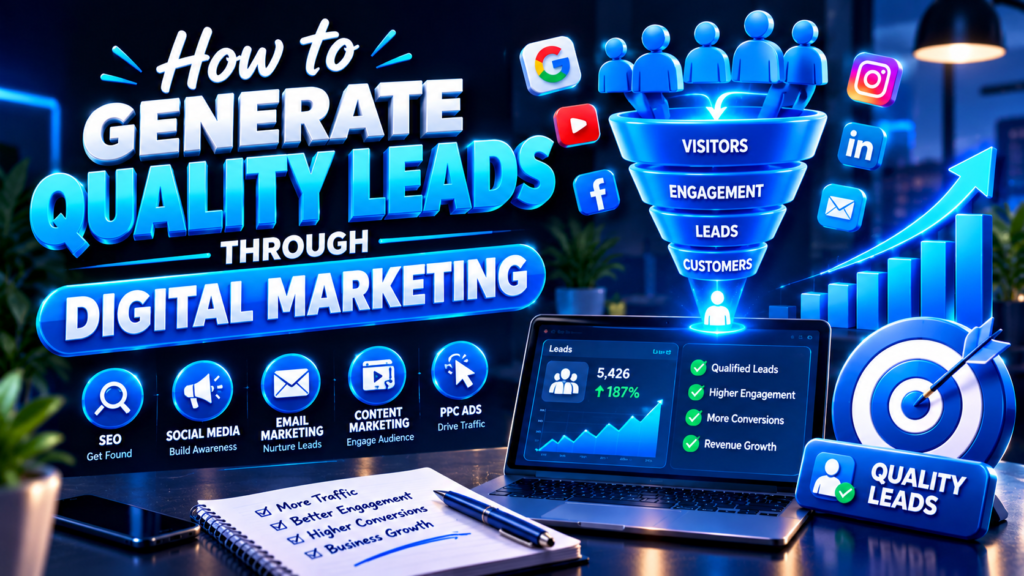
Generating leads is one of the most important objectives of digital marketing. However, attracting website visitors alone does not guarantee business growth. Companies need to reach the right audience, understand their needs, and encourage potential customers to take meaningful action. Therefore, businesses must develop a strategic approach that transforms online visibility into qualified leads and long-term customer relationships.
In today’s competitive digital landscape, digital marketing lead generation involves several interconnected strategies, including search engine optimization, content marketing, social media marketing, email campaigns, and paid advertising. When businesses combine these techniques effectively, they can attract relevant prospects and guide them through the customer journey. This article explores ten proven strategies to generate quality leads through digital marketing and improve overall business growth.
1. Understand Your Target Audience Before Generating Leads
Successful lead generation begins with a clear understanding of your target audience. Businesses must identify their ideal customers, including their interests, challenges, purchasing behavior, and needs. Without this information, marketing campaigns may attract people who have little interest in the products or services offered.
To develop an effective audience profile, analyze existing customer data, conduct surveys, review customer feedback, and research competitors. Additionally, create an ideal customer profile that describes the people most likely to benefit from your services. Consequently, you can develop relevant marketing messages that attract qualified prospects rather than focusing exclusively on increasing website traffic.
2. Use Search Engine Optimization to Attract High-Intent Leads
Search engine optimization (SEO) helps businesses attract potential customers who actively search for relevant information, products, or services. For example, someone searching for a digital marketing agency may already be considering professional marketing support. Therefore, appearing in relevant search results can connect your business with people who have a genuine interest in your services.
To improve lead generation through SEO, conduct keyword research, optimize website pages, create useful blog content, and improve website performance. Furthermore, target keywords that reflect commercial intent, such as “digital marketing agency for small businesses” or “SEO services for local businesses.” By addressing search intent and providing valuable information, your website can attract qualified organic traffic and generate more relevant inquiries over time.
3. Create Valuable Content That Converts Visitors into Leads
Content marketing allows businesses to demonstrate expertise while helping potential customers solve problems. Blog posts, industry guides, case studies, checklists, and educational videos can answer customer questions and establish credibility. As a result, visitors become more familiar with your brand and may feel more confident about contacting your business.
However, publishing content alone is not enough. Each piece should support a specific marketing objective and guide readers toward an appropriate next step. For example, a blog post about SEO challenges could encourage readers to request a website audit. Similarly, a downloadable marketing checklist could help visitors understand your services while inviting them to subscribe to your email list.
4. Leverage Social Media Marketing to Reach Potential Customers
Social media marketing provides opportunities to connect with potential customers, increase brand awareness, and build trust. Platforms such as Instagram, Facebook, LinkedIn, and YouTube allow businesses to share educational content, demonstrate their expertise, and communicate directly with their audiences. Consequently, social media can become an important source of quality leads when businesses use it strategically.
To generate leads through social media, publish useful posts, share customer success stories, answer audience questions, and include clear calls to action. In addition, select platforms based on your audience rather than trying to maintain an equally strong presence everywhere. A business targeting corporate decision-makers, for instance, may benefit from LinkedIn, while a visually focused brand may find Instagram and YouTube more suitable.
5. Run Targeted Paid Advertising Campaigns
Paid advertising can help businesses reach potential customers quickly. Google Ads enables companies to appear when users search for specific products or services, while Meta Ads can introduce relevant offers to audiences on Facebook and Instagram. Therefore, businesses can use paid advertising to generate targeted website visits, inquiries, and sales opportunities.
Nevertheless, successful campaigns require careful planning. Define your campaign objective, select relevant keywords or audience segments, create compelling advertisements, and direct users to a dedicated landing page. Moreover, track cost per lead, conversion rate, and lead quality instead of measuring success through clicks alone. By testing different advertisements and improving campaign targeting, businesses can make more informed decisions about their advertising budgets.
6. Optimize Landing Pages for Better Lead Conversion
A landing page is designed to encourage visitors to complete a specific action, such as requesting a consultation, registering for an event, or submitting an inquiry. Even when marketing campaigns attract relevant traffic, a confusing or poorly designed landing page can prevent visitors from becoming leads. Therefore, businesses should make conversion optimization a central part of their digital marketing strategy.
An effective landing page should include a clear headline, concise benefits, relevant supporting information, and a prominent call-to-action button. Additionally, keep forms simple and request only the information necessary to follow up with the prospect. Trust signals, testimonials, and clear explanations of your services can further reduce uncertainty and encourage visitors to take the next step.
7. Use Email Marketing to Nurture Potential Customers
Not every prospect will make a purchasing decision immediately. Some people need more information, while others may compare several service providers before choosing one. Email marketing helps businesses maintain communication with these prospects by delivering relevant information and guiding them toward a decision.
Start by building an email list through legitimate sign-up forms, useful resources, or consultation requests. Then, segment subscribers according to their interests and interactions with your business. For example, a person interested in SEO could receive educational emails about search optimization, while someone interested in paid advertising could receive information about campaign planning. As a result, your messages become more relevant and your lead-nurturing efforts become more effective.
8. Build Trust Through Testimonials and Case Studies
Trust plays a major role in the decision-making process. Potential customers often want evidence that a business can deliver the results it promises. Testimonials, customer reviews, case studies, and project examples provide valuable proof of your experience and help prospects evaluate your credibility.
To strengthen your lead generation strategy, showcase genuine customer feedback and explain how your services addressed specific business challenges. Whenever possible, include measurable outcomes and describe the methods used to achieve them. However, ensure that all claims remain accurate and verifiable. Authentic social proof helps potential customers make informed decisions and can increase the likelihood that they will contact your business.
9. Implement Lead Magnets and Clear Calls to Action
A lead magnet is a useful resource that businesses offer in exchange for a visitor’s contact information. Examples include downloadable guides, templates, checklists, educational webinars, and industry reports. When these resources address a specific audience problem, they can encourage interested visitors to share their information and enter the lead-generation process.
However, a lead magnet must offer genuine value rather than simply collect email addresses. For example, a digital marketing agency could provide a free SEO checklist or a website performance assessment. Pair the resource with a clear call to action, such as “Download the Free Guide” or “Request a Website Audit.” Subsequently, follow up with relevant information that helps the prospect understand the available solutions.
10. Track Analytics and Continuously Improve Your Strategy
Digital marketing analytics help businesses understand which campaigns generate the most valuable leads. By monitoring website traffic, conversion rates, lead sources, advertising costs, and customer acquisition metrics, marketers can identify successful activities and improve underperforming campaigns. Consequently, businesses can allocate resources more effectively and make decisions based on evidence rather than assumptions.
Use suitable analytics and customer relationship management (CRM) tools to track prospects from their first interaction through the sales process. Additionally, coordinate with your sales team to determine which leads become genuine opportunities or paying customers. This feedback helps distinguish high-quality leads from inquiries that are unlikely to convert. Over time, consistent measurement and optimization can improve marketing efficiency and support sustainable growth.
11. Combine Multiple Digital Marketing Channels for Better Results
Although individual marketing channels can generate leads, combining several complementary strategies often creates a more consistent customer journey. For instance, SEO may attract a visitor to a blog post, social media may increase brand familiarity, and email marketing may encourage that visitor to request a consultation. Therefore, an integrated digital marketing strategy can strengthen the impact of individual campaigns.
To implement this approach, develop a content calendar, maintain consistent brand messaging, and create clear pathways between your marketing channels. Furthermore, ensure that every channel supports a defined objective. By connecting content marketing, SEO, paid advertising, social media, and email campaigns, businesses can create a coordinated system that attracts prospects, builds trust, and converts interest into qualified leads.
Best Practices for Generating Quality Leads Through Digital Marketing
Businesses should prioritize lead quality rather than focusing only on the number of inquiries. Define what makes a lead valuable, identify the characteristics of your ideal customer, and develop campaigns that address relevant needs. In addition, make your website easy to navigate, provide accurate service information, and offer clear next steps for visitors who want to learn more.
Consistency and continuous improvement are equally important. Review campaign performance regularly, test different headlines and calls to action, and update content according to audience behavior. Moreover, respect customer privacy, obtain appropriate consent when collecting personal information, and communicate transparently about how you use contact details. These practices support stronger customer relationships and create a more reliable lead-generation process.
Conclusion: Turn Your Digital Marketing Strategy into a Lead-Generation System
Generating quality leads through digital marketing requires more than attracting website visitors or publishing social media posts. Businesses must understand their audiences, provide valuable information, build trust, and guide potential customers toward meaningful actions. By combining SEO, content marketing, social media, paid advertising, landing page optimization, and email marketing, companies can develop a comprehensive approach to lead generation.
Ultimately, the most effective digital marketing strategy focuses on attracting the right people and helping them make informed decisions. Track your results, learn from customer behavior, and continually improve your campaigns. With a clear strategy and consistent execution, businesses can generate qualified leads, strengthen customer relationships, and create sustainable opportunities for long-term growth.
Frequently Asked Questions (FAQs)
1. What is lead generation in digital marketing?
Lead generation in digital marketing is the process of attracting potential customers and encouraging them to express interest in a business’s products or services through actions such as submitting forms, requesting consultations, or subscribing to email updates.
2. Which digital marketing strategy is best for generating quality leads?
The best strategy depends on your audience and business objectives. SEO can attract high-intent organic traffic, paid advertising can reach targeted audiences quickly, and content marketing can build trust. Combining these methods often creates a more comprehensive approach.
3. How can a digital marketing agency generate more leads?
A digital marketing agency can generate leads by optimizing its website for SEO, publishing educational blog posts, sharing case studies, running targeted advertising campaigns, offering free consultations, and using landing pages with clear calls to action.
4. How do you measure lead-generation success?
Measure conversion rates, cost per lead, lead-to-customer conversion rates, qualified lead volume, and customer acquisition costs. These metrics provide a clearer picture of campaign performance than website traffic or clicks alone.